About
A developer who became a designer, and kept the toolbox.
I grew up in India drawn to logical puzzles, which led me into computer programming and then a job as a front-end developer at Cisco. Somewhere in those years I noticed the problems I found most interesting weren’t in the code. They were in why people struggled with what we’d built.
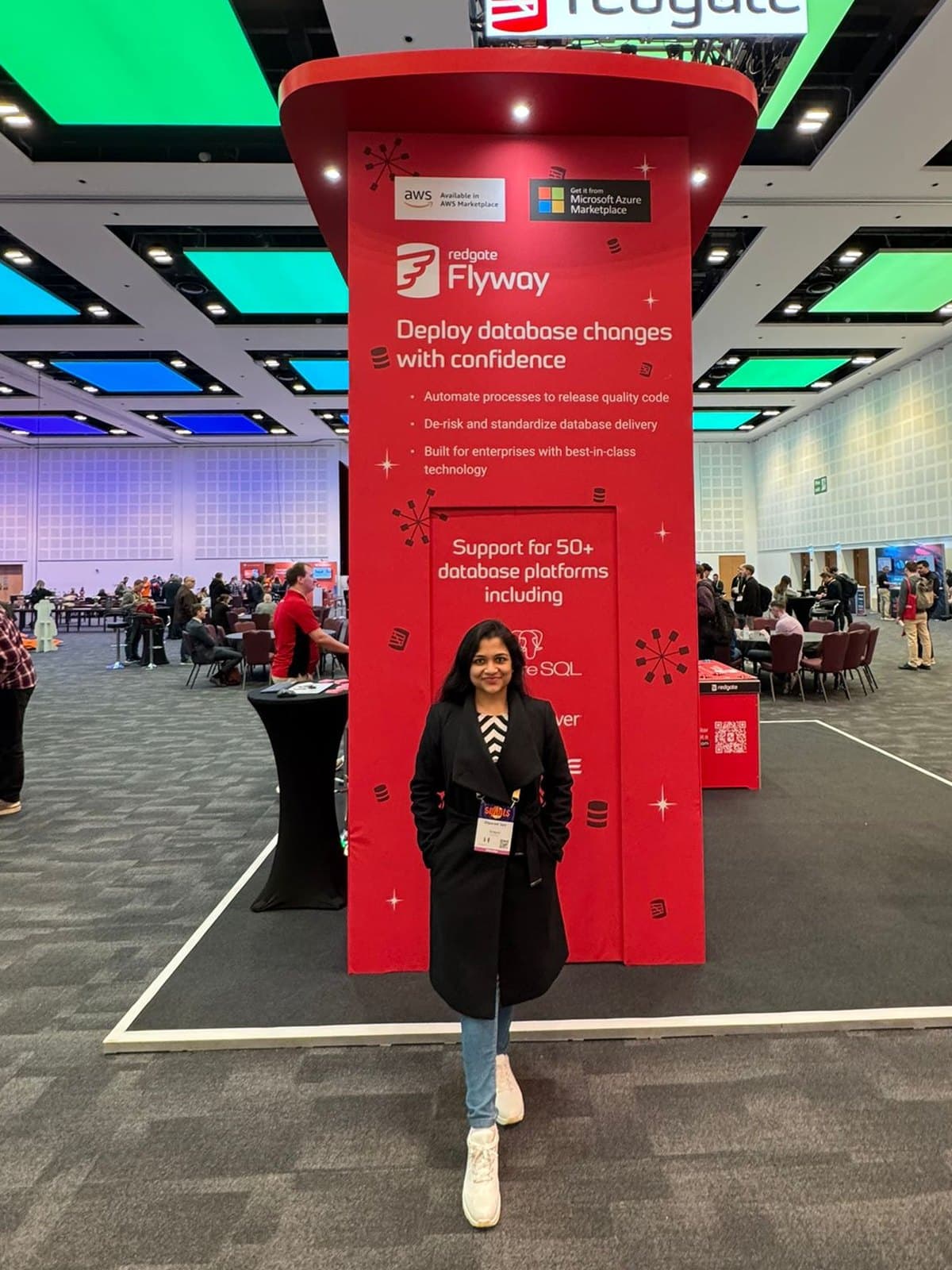
So I moved into UX design at Cisco, then left to do an MSc in Human Computer Interaction at the University of Bath. After graduating I joined Adsum, a London fintech, as the founding product designer, where I designed and built the product interfaces myself. Since 2025 I’ve been a Product Designer at Redgate, working on Flyway, their database DevOps product: research, interaction design, and a fair amount of AI and developer-tooling work.
The developer background isn’t my job title, but it shapes how I work. I’m comfortable in technical products, I can talk to engineers about feasibility without a translator, and I can prototype in code when a Figma file won’t answer the question.
How I tend to work
Four habits, with the evidence.
Get close to the problem
When I was researching how customers use AI with Flyway, I set the MCP server up myself. It surfaced documentation gaps and a packaging issue I could hand to engineering as specific evidence, not a vague “setup is hard”. Same instinct at SQLBits: stand at the booth and talk to DBAs.
Use evidence, then apply judgement
Telemetry told us 20.7% of people were leaving Flyway Desktop’s launch page. It didn’t say why. Forming the hypothesis, choosing the smallest change that would test it, and reading the result: that’s the design work. The data is the start of it, not the end.
Work closely with engineering
I run a Friday design review with the engineers I work with, so changes get looked at while they’re being built rather than after. When it’s quicker to fix something myself, I open the PR. I also wrote a small tool so other designers on the team can do the same.
Make the thinking easy to share
Research one-pagers, Mural boards, clickable prototypes with the unhappy paths included. If people can’t see the reasoning, they can’t challenge it, and the work doesn’t get better.
What a supervisor said
“Diparati’s collaborative nature and strong communication skills greatly contributed to her ability to work effectively within a team.”
Diparati stood out as truly dedicated and diligent. She consistently displayed a strong passion for designing and prototyping, which was reflected in her coursework and the project she undertook under my guidance.
Beyond the work
Mandalas, psychology, podcasts.
I draw mandala and Zentangle art, and I’m a Certified Zentangle Teacher. What started as a way to switch off became a small business, Entangled in Zentangle, with the drawings on t-shirts, stickers and tote bags. The line motifs on this site are a quieter cousin of that work.
I read about human psychology and how it feeds into design, I listen to podcasts on most walks, and I’ve been a guest on a couple of them (there’s a list on the speaking page). You can see the art on Instagram.
A small game
Three facts. One of them is false. Which one?
Pick one to find out.